Showing posts with label Fighter/Attack. Show all posts

Monday, May 2, 2011

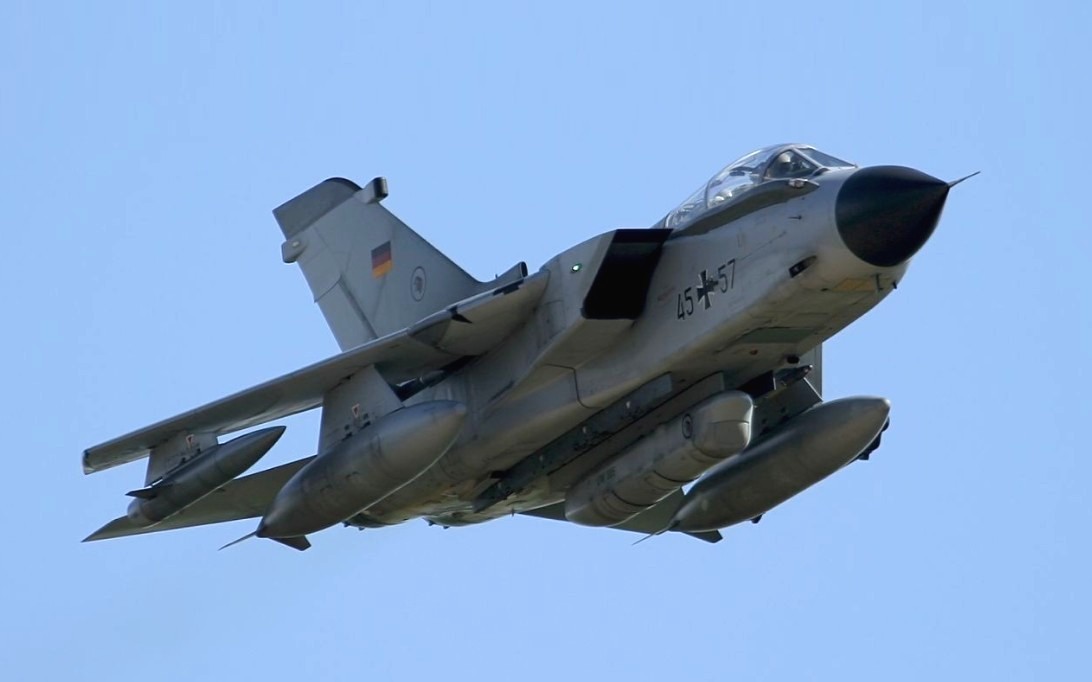
Tornado IDS (Wallpaper 1)

Tornado IDS
size image : 1092 x 682
Tornado IDS (Wallpaper 1)
Tornado IDS fighter aircraft photo wallpaper gallery 1. Tornado IDS fighter airplane pictures and images collection 1.
The Panavia Tornado is a family of twin-engine, variable-sweep wing combat aircraft, which was jointly developed by the United Kingdom, West Germany and Italy. There are three primary versions of the Tornado; the Tornado IDS (interdictor/strike) fighter-bomber, the suppression of enemy air defences Tornado ECR (electronic combat/reconnaissance) and the Tornado ADV (air defence variant) interceptor. Developed and built by Panavia, a tri-national consortium consisting of British Aerospace (previously British Aircraft Corporation), MBB of West Germany, and Aeritalia of Italy, the Tornado first flew on 14 August 1974, and saw action with the Royal Air Force (RAF), Italian Air Force and Royal Saudi Air Force in the Gulf War. International co-operation continued after its entry into service within the Tri-National Tornado Training Establishment, a tri-nation training and evaluation unit operating from RAF Cottesmore, UK. Including all variants, 992 aircraft were built for the three partner nations and Saudi Arabia. During the 1960s, aeronautical designers looked to variable geometry wing designs to gain the manoeuvrability and efficient cruise of straight wings with the speed of swept-wing designs. Tornado IDS (Wallpaper 1). Tornado IDS fighter aircraft photo wallpaper gallery 1. Tornado IDS fighter airplane pictures and images collection 1. The United Kingdom had cancelled the procurement of the TSR-2 and subsequent F-111K aircraft, and was still looking for a replacement for its Avro Vulcan and Blackburn Buccaneer strike aircraft. Britain and France had initiated the AFVG (Anglo French Variable Geometry) project in 1965, but this had ended with French withdrawal in 1967. Britain continued to develop a variable geometry aircraft similar to the proposed AFVG, and sought out new partners in order to achieve this. In 1968, West Germany, the Netherlands, Belgium, Italy, and Canada formed a working group to examine replacements for the F-104 Starfighter, initially called the Multi Role Aircraft (MRA), later renamed as the Multi Role Combat Aircraft (MRCA). The participating nations all had aging fleets that required replacing, but as the requirements were so diverse it was decided to develop a single aircraft that could perform a variety of missions that were previously undertaken by a fleet of different aircraft. Britain joined the MRCA group in 1968, represented by Air Vice-Marshal Michael Giddings, and a memorandum of agreement was drafted between Britain, West Germany, and Italy in May 1969. By the end of 1968, the prospective purchases from the six countries amounted to 1500 aircraft. Canada and Belgium had departed before any long-term commitments had been made to the program; Canada had found the project politically unpalatable; there was a perception in political circles that much of the manufacturing and specifications were focused upon Western Europe. France had made a favourable offer to Belgium on the Dassault Mirage S, which created suitable doubt about whether the MRCA would be worthwhile from Belgium's operational perspective. Tornado IDS (Wallpaper 1). Tornado IDS fighter aircraft photo wallpaper gallery 1. Tornado IDS fighter airplane pictures and images collection 1.
Tornado IDS (Wallpaper 2)
Tornado IDS (Wallpaper 3)
Tornado IDS (Wallpaper 4)

Saturday, April 30, 2011

F-4 Phantom II (wallpaper 1)

F-4 Phantom II 1
size image : 1092 x 682
F-4 Phantom II (wallpaper 1)
F-4 Phantom II fighter aircraft images wallpaper gallery 1. F-4 Phantom II fighter airplane pictures and images collection 1.
The McDonnell Douglas F-4 Phantom II is a tandem two-seat, twin-engined, all-weather, long-range supersonic jet interceptor fighter/fighter-bomber originally developed for the United States Navy by McDonnell Aircraft. It first entered service in 1960 with the U.S. Navy. Proving highly adaptable, it was also adopted by the U.S. Marine Corps and the U.S. Air Force, and by the mid-1960s had became a major part of their respective air wings. The Phantom is a large fighter with a top speed of over Mach 2. It can carry over 18,000 pounds (8,400 kg) of weapons on nine external hardpoints, including air-to-air and air-to-ground missiles, and various bombs. The F-4, like other interceptors of its time, was designed without an internal cannon, but later models incorporated a M61 Vulcan rotary cannon. Beginning in 1959, it set 15 world records, including an absolute speed record, and an absolute altitude record. F-4 Phantom II (wallpaper 1). F-4 Phantom II fighter aircraft images wallpaper gallery 1. F-4 Phantom II fighter airplane pictures and images collection 1. The F-4 was used extensively by these three U.S. services during the Vietnam War, serving as the principal air superiority fighter for both the Navy and Air Force, as well as being important in the ground-attack and reconnaissance roles by the close of U.S. involvement in the war. The Phantom has the distinction of being the last U.S. fighter flown to attain ace status in the 20th century. During the Vietnam War, the USAF had one pilot and two WSOs, and the US Navy one pilot and one RIO, become aces in air-to-air combat. It continued to form a major part of U.S. military air power throughout the 1970s and 1980s, being gradually replaced by more modern aircraft such as the F-15 Eagle and F-16 in the U.S. Air Force; the Grumman F-14 Tomcat and F/A-18 Hornet in the U.S. Navy; and the F/A-18 in the U.S. Marine Corps. The F-4 Phantom II remained in use by the U.S. in the reconnaissance and Wild Weasel (suppression of enemy air defenses) roles in the 1991 Gulf War, finally leaving service in 1996. It was also the only aircraft used by both U.S. flight demonstration teams: the USAF Thunderbirds (F-4E) and the US Navy Blue Angels (F-4J). The F-4 was also operated by the armed forces of 11 other nations. Israeli Phantoms saw extensive combat in several Arab–Israeli conflicts, while Iran used its large fleet of Phantoms in the Iran–Iraq War. Phantoms remain in front line service with seven countries, and in use as an unmanned target in the U.S. Air Force. Phantom production ran from 1958 to 1981, with a total of 5,195 built, making it the most numerous American supersonic military aircraft. F-4 Phantom II (wallpaper 1). F-4 Phantom II fighter aircraft images wallpaper gallery 1. F-4 Phantom II fighter airplane pictures and images collection 1.
F-4 Phantom II (Wallpaper 2)
F-4 Phantom II (Wallpaper 3)
F-4 Phantom II (Wallpaper 4)

Friday, April 15, 2011

MiG-31 Foxhound

MiG-31 Foxhound wallpaper 1
size image : 1092 x 682
MiG-31 Foxhound (wallpaper 1)
MiG-31 Foxhound aircraft images wallpaper gallery 1. MiG-31 Foxhound airplane pictures and images collection 1.
Fighter and Attack Aircraft. The Mikoyan MiG-31 (Russian: Микоян МиГ-31; NATO reporting name: Foxhound) is a supersonic interceptor aircraft developed to replace the MiG-25 "Foxbat". The MiG-31 was designed by the Mikoyan design bureau based on the MiG-25. The MiG-25 "Foxbat", despite Western panic about its tremendous performance, made substantial design sacrifices in capability for the sake of achieving high speed, altitude, and rate of climb. It lacked maneuverability at interception speeds, was difficult to fly at low altitudes, and its inefficient turbojet engines resulted in a very short combat range at supersonic speeds. The MiG-25's speed gauge was redlined at Mach 2.8, and pilots were instructed not to top Mach 2.5 in order to prolong the life of the engines. Achieving the MiG-25's maximum potential speed of Mach 3.2 would result in destroying the engines. Development of the MiG-25's replacement began with the Ye-155MP (Russian: Е-155МП) prototype which first flew on 16 September 1975. Although it bore a superficial resemblance to a stretched MiG-25 with a longer fuselage for the radar operator cockpit, it was in many respects a new design. The MiG-25 used 80% nickel steel in its structure to allow welding. MiG-31 Foxhound (wallpaper 1). MiG-31 Foxhound aircraft images wallpaper gallery 1. MiG-31 Foxhound airplane pictures and images collection 1. The Ye-155MP doubled the use of titanium to 16% and tripled the aluminium content to 33% to reduce structural mass. More importantly, supersonic speed was now possible at low altitudes. Fuel capacity was also increased, and new, more efficient low bypass ratio turbofan engines were fitted. The most important development was introducing an advanced radar capable of both look-up and look-down engagement (locating targets above and below the aircraft), as well as multiple target tracking. This finally gave the Soviets an interceptor able to engage the most likely Western intruders at long range. It also reflected a policy shift from reliance on ground-controlled interception (GCI) to greater autonomy for flight crews. Like its MiG-25 predecessor, the MiG-31 was surrounded by early speculation and misinformation concerning its design and abilities. The West learned of the new interceptor from Lieutenant Viktor Belenko, a pilot who defected to Japan in 1976 with his MiG-25P. Belenko described an upcoming "Super Foxbat" with two seats and an ability to intercept cruise missiles. According to his testimony, the new interceptor was to have air intakes similar to the Mikoyan-Gurevich MiG-23, which the MiG-31 does not have, at least not in production variants. While the MiG-31 was undergoing testing, an unknown aircraft was spotted by a reconnaissance satellite at the Zhukovsky flight test center near the town of Ramenskoye. The images were interpreted as a fixed-wing interceptor version of a swing-wing fighter codenamed "Ram-K". The latter was eventually revealed to be the Sukhoi Su-27 'Flanker', a wholly unrelated design. MiG-31 Foxhound (wallpaper 1). MiG-31 Foxhound aircraft images wallpaper gallery 1. MiG-31 Foxhound airplane pictures and images collection 1.
MiG-31 Foxhound (Wallpaper 2)
MiG-31 Foxhound (Wallpaper 3)
MiG-31 Foxhound (Wallpaper 4)

Monday, April 11, 2011

SEPECAT Jaguar

SEPECAT Jaguar wallpaper 1
size image : 1092 x 682
SEPECAT Jaguar (wallpaper 4)
SEPECAT Jaguar aircraft images wallpaper gallery 4. SEPECAT Jaguar airplane pictures and images collection 4.
Fighter and Attack Aircraft. The SEPECAT Jaguar is an Anglo-French jet ground attack aircraft, originally used by the British Royal Air Force and the French Armée de l'Air in the close air support and nuclear strike role, and still in service with several export customers, notably the Indian Air Force and the Royal Air Force of Oman. Originally conceived in the 1960s as jet trainer with a light ground attack capability, the requirement for the aircraft soon changed to include supersonic performance, reconnaissance and tactical nuclear strike roles. A carrier-based variant was also planned for French service, but this was cancelled in favour of the cheaper Dassault Super Étendard. The airframes were manufactured by SEPECAT, a joint venture between Breguet and the British Aircraft Corporation, one of the first major joint-Anglo-French military aircraft programs. SEPECAT Jaguar (wallpaper 4). SEPECAT Jaguar aircraft images wallpaper gallery 4. SEPECAT Jaguar airplane pictures and images collection 4. The Jaguar was successfully exported to India, Oman, Ecuador and Nigeria. With various airforces, the Jaguar was used in numerous conflicts and military operations in Mauritania, Chad, Iraq, Bosnia, and Pakistan, as well as providing a ready nuclear delivery platform for Britain, France, and India throughout the latter half of the Cold War and beyond. In the Gulf War, the Jaguar was praised for its reliability and was a valuable coalition resource. The aircraft served with the Armée de l'Air as the main strike/attack aircraft until 1 July 2005, and with the Royal Air Force until the end of April 2007. It was replaced by the Panavia Tornado and the Eurofighter Typhoon in the RAF and the Dassault Rafale in the Armée de l'Air. India plans in the long term to replace its Jaguar fleet with the developing Advanced Medium Combat Aircraft (AMCA). The Jaguar program began in the early 1960s, in response to a British requirement (Air Staff Target 362) for an advanced supersonic jet trainer to replace the Folland Gnat T1 and Hawker Hunter T7, and a French requirement (the École de Combat et d'Appui Tactique, "Tactical Combat Support Trainer") for a cheap, subsonic dual role trainer and light attack aircraft to replace the Fouga Magister, Lockheed T-33 and Dassault Mystère IV. In both countries several companies tendered designs: BAC, Hunting, Hawker Siddeley and Folland in Britain; Breguet, Potez, Sud-Aviation, Nord, and Dassault from France. A Memorandum of Understanding was signed in May 1965 for the joint venture to develop two aircraft, a trainer and the Anglo-French Variable Geometry (AFVG) Aircraft. SEPECAT Jaguar (wallpaper 4). SEPECAT Jaguar aircraft images wallpaper gallery 4. SEPECAT Jaguar airplane pictures and images collection 4.

Saturday, April 9, 2011

Super Étendard

Super Étendard wallpaper 1
size image : 1092 x 682
Super Étendard (wallpaper 1)
Super Étendard aircraft images wallpaper gallery 1. Super Étendard airplane pictures and images collection 1.
Fighter and Attack Aircraft. The Dassault-Breguet Super Étendard (French for "battle flag") is a French carrier-borne strike fighter aircraft designed for service with the French Navy. The aircraft entered service in June 1978 and was first used in combat by Argentina during the 1982 Falklands War. The Super Étendard is a development of the earlier Étendard IVM that was originally to have been replaced by a navalised version of the SEPECAT Jaguar (the Jaguar M), until this plan was stalled by political problems, together with problems with operating the Jaguar aboard ships, including the inability to land back on a carrier after an engine failure. Instead, Dassault proposed an improved version of the Étendard IVM, with a more powerful engine, a new wing and improved avionics. This proposal was accepted by the French Navy in 1973 as the Super Étendard. The Super Étendard is a small, single-engined, mid-winged aircraft with an all metal structure. Both the wings and tailplane are swept, with the folding wings having a sweepback of about 45 degrees, while the aircraft is powered by a non-afterburning SNECMA Atar 9K-50 turbojet with a rating of 49 kN (11,025 lbf). Super Étendard (wallpaper 1). Super Étendard aircraft images wallpaper gallery 1. Super Étendard airplane pictures and images collection 1. It is fitted with a Thomson-CSF Agave radar, closely integrated with the new air-launched version of Aérospatiale's anti-shipping missile, the AM 39 Exocet, which forms the main anti-ship armament of the aircraft. French Étendards could also carry tactical nuclear weapons. The first of three prototypes, a IVM modified with the new engine and some of the new avionics, made its maiden flight on 28 October 1974. The French Navy initially ordered 60 of the new model, with options for a further 20, but budget cuts lead to only 71 being purchased in the end, with deliveries starting in June 1978, while the Argentinian Navy ordered a further 14. Production was completed in 1983. The Argentine Naval Aviation decided to buy 14 Super Étendards in 1980, after the United States put an arms embargo in place—due to the Dirty War—and refused to supply spare parts for their A-4Q Skyhawks. Assigned to 2nd Naval Air Fighter/Attack Squadron, Argentine pilots used French flight trainers between November 1980 and August 1981 in France, but at the time of the Falklands War, they had received only 45 hours of actual flight time in the aircraft. Between August and November 1981, five Super Étendards and five Exocets were shipped to Argentina. All five of the missiles were used during the conflict, with one missile hitting the British destroyer HMS Sheffield and two the merchant aircraft transporter Atlantic Conveyor. Two missiles were used in each of those attacks. Super Étendard (wallpaper 1). Super Étendard aircraft images wallpaper gallery 1. Super Étendard airplane pictures and images collection 1.

Friday, April 8, 2011

A-4 Skyhawk

A-4 Skyhawk wallpaper 1
size image : 1092 x 682
A-4 Skyhawk (wallpaper 1)
A-4 Skyhawk aircraft images wallpaper gallery 1. A-4 Skyhawk airplane pictures and images collection 1.
Fighter and Attack Aircraft. The Douglas A-4 Skyhawk is a carrier-capable ground-attack aircraft designed for the United States Navy and United States Marine Corps. The delta winged, single-engined Skyhawk was designed and produced by Douglas Aircraft Company, and later McDonnell Douglas. It was originally designated the A4D under the U.S. Navy's pre-1962 designation system. Skyhawks played key roles in the Vietnam War, the Yom Kippur War, and the Falklands War. Fifty years after the aircraft's first flight, some of the nearly 3,000 produced remain in service with several air arms around the world, including with the Brazilian Navy's aircraft carrier, São Paulo. The Skyhawk was designed by Douglas Aircraft's Ed Heinemann in response to a U.S. Navy call for a jet-powered attack aircraft to replace the older AD Skyraider. A-4 Skyhawk (wallpaper 1). A-4 Skyhawk aircraft images wallpaper gallery 1. A-4 Skyhawk airplane pictures and images collection 1. Heinemann opted for a design that would minimize its size, weight, and complexity. The result was an aircraft that weighed only half of the Navy's weight specification. It had a wing so compact that it did not need to be folded for carrier stowage. The diminutive Skyhawk soon received the nicknames "Scooter", "Kiddiecar", "Bantam Bomber", "Tinker Toy Bomber", and, on account of its nimble performance, "Heinemann's Hot-Rod".The aircraft is of conventional post-World War II design, with a low-mounted delta wing, tricycle undercarriage, and a single turbojet engine in the rear fuselage, with two air intakes on the fuselage sides. The tail is of cruciform design, with the horizontal stabilizer mounted above the fuselage. Armament consisted of two 20 mm (.79 in caliber) Colt Mk 12 cannons, one in each wing root, with 200 rpg, plus a large variety of bombs, rockets, and missiles carried on a hardpoint under the fuselage centerline and hardpoints under each wing (originally one per wing, later two). A-4 Skyhawk (wallpaper 1). A-4 Skyhawk aircraft images wallpaper gallery 1. A-4 Skyhawk airplane pictures and images collection 1.

Sunday, April 3, 2011

F-14 Tomcat

F-14 Tomcat wallpaper 1size image : 1092 x 682
F-14 Tomcat (wallpaper 1)
F-14 Tomcat aircraft images wallpaper gallery 1. F-14 Tomcat airplane pictures and images collection 1.
Fighter and Attack Aircraft. The Grumman F-14 Tomcat is a supersonic, twin-engine, two-seat, variable-sweep wing fighter aircraft. The Tomcat was developed for United States Navy's Naval Fighter Experimental (VFX) program following the collapse of the F-111B project. The F-14 was the first of the American teen-series fighters which were designed incorporating the experience of air combat against MiGs during the Vietnam War. The F-14 first flew in December 1970. It first deployed in 1974 with the U.S. Navy aboard USS Enterprise (CVN-65), replacing the F-4 Phantom II. The F-14 served as the U.S. Navy's primary maritime air superiority fighter, fleet defense interceptor and tactical reconnaissance platform. In the 1990s it added the Low Altitude Navigation and Targeting Infrared for Night (LANTIRN) pod system and began performing precision strike missions. The F-14 was retired from the active U.S. Navy fleet on 22 September 2006, having been replaced by the F/A-18E/F Super Hornet. As of 2009, the F-14 was only in service with the Islamic Republic of Iran Air Force, having been exported to Iran in 1976 when the US had amicable diplomatic relations with the nation. F-14 Tomcat (wallpaper 1). F-14 Tomcat aircraft images wallpaper gallery 1. F-14 Tomcat airplane pictures and images collection 1. The F-14 Tomcat was designed as both an air superiority fighter and a long-range naval interceptor. The F-14 has a two-seat cockpit with a canopy that affords all-round visibility. It features variable geometry wings that swing automatically during flight. For high-speed intercept, they are swept back and they swing forward for lower speed flight. It was designed to improve on the F-4 Phantom's air combat performance in most respects. The F-14's fuselage and wings allow it to climb faster than the F-4, while the twin-tail arrangement offers better stability. The F-14 is equipped with an internal 20 mm M61 Vulcan Gatling-type gun mounted on the left side, and can carry AIM-54 Phoenix, AIM-7 Sparrow, and AIM-9 Sidewinder anti-aircraft missiles. The fuselage consists of a large flat area called the "pancake" between the engine nacelles and, by itself, provides more than half of the F-14's aerodynamic lifting surface. Fuel, electronics, flight controls, and the wing-sweep mechanism are all housed in the fuselage "pancake". The wings pivot from two extensions on either side of the "pancake", called wing gloves. The twin engines are housed in nacelles below and slightly to the rear, with the fuselage smoothly blending into the shape of the exhaust nozzles. The nacelles are spaced apart 1 to 3 ft (0.30 to 0.91 m). This produces a wide tunnel between the nacelles which causes some drag, but adds considerable lift and pitching ability. The resultant tunnel provides space to carry Phoenix or Sparrow missiles, assorted bombs, or the TARPS reconnaissance pod, and increases fuel capacity and room for equipment. F-14 Tomcat (wallpaper 1). F-14 Tomcat aircraft images wallpaper gallery 1. F-14 Tomcat airplane pictures and images collection 1.

Saturday, April 2, 2011

F-15 Eagle (wallpaper 1)

F-15 Eagle wallpaper 1

size image : 1092 x 682

F-15 Eagle (wallpaper 1)
F-15 Eagle aircraft images wallpaper gallery 1. F-15 Eagle airplane pictures and images collection 1.
Fighter and Attack Aircraft. The Eagle's air superiority is achieved through a mixture of unprecedented maneuverability and acceleration, range, weapons and avionics. It can penetrate enemy defense and outperform and outfight any current enemy aircraft. The F-15 has electronic systems and weaponry to detect, acquire, track and attack enemy aircraft while operating in friendly or enemy-controlled airspace. The weapons and flight control systems are designed so one person can safely and effectively perform air-to-air combat. The F-15's superior maneuverability and acceleration are achieved through high engine thrust-to-weight ratio and low wing loading. Low wing-loading (the ratio of aircraft weight to its wing area) is a vital factor in maneuverability and, combined with the high thrust-to-weight ratio, enables the aircraft to turn tightly without losing airspeed. A multimission avionics system sets the F-15 apart from other fighter aircraft. F-15 Eagle (wallpaper 1). F-15 Eagle aircraft images wallpaper gallery 1. F-15 Eagle airplane pictures and images collection 1. It includes a head-up display, advanced radar, inertial navigation system, flight instruments, ultrahigh frequency communications, tactical navigation system and instrument landing system. It also has an internally mounted, tactical electronic-warfare system, "identification friend or foe" system, electronic countermeasures set and a central digital computer. The head-up display projects on the windscreen all essential flight information gathered by the integrated avionics system. This display, visible in any light condition, provides the pilot information necessary to track and destroy an enemy aircraft without having to look down at cockpit instruments. The F-15's versatile pulse-Doppler radar system can look up at high-flying targets and down at low-flying targets without being confused by ground clutter. It can detect and track aircraft and small high-speed targets at distances beyond visual range down to close range, and at altitudes down to treetop level. The radar feeds target information into the central computer for effective weapons delivery. For close-in dogfights, the radar automatically acquires enemy aircraft, and this information is projected on the head-up display. The F-15's electronic warfare system provides both threat warning and automatic countermeasures against selected threats. F-15 Eagle (wallpaper 1). F-15 Eagle aircraft images wallpaper gallery 1. F-15 Eagle airplane pictures and images collection 1.
F-15 Eagle (Wallpaper 2)
F-15 Eagle (Wallpaper 3)
F-15 Eagle (Wallpaper 4)

Tuesday, March 29, 2011

A-10 Thunderbolt (wallpaper 1)

A-10 Thunderbolt wallpaper 1

size image : 1092 x 682

A-10 Thunderbolt (wallpaper 1)
A-10 Thunderbolt aircraft images wallpaper gallery 1. A-10 Thunderbolt airplane pictures and images collection 1.
The A-10 Thunderbolt is also known as the Warthog, the 'flying gun' and the Tankbuster. The aircraft was used extensively during Operation Desert Storm, in support of Nato operations in response to the Kosovo crisis, in Operation Enduring Freedom in Afghanistan and in Operation Iraqi Freedom. The A-10 is a high-survivability and versatile aircraft, popular with pilots for the 'get home' effectiveness. The mission of the aircraft is ground attack against tanks, armoured vehicles and installations, and close air support of ground forces. The aircraft is suitable for operation from forward air bases, with short take-off and landing capability. The aircraft has a long range (800 miles), high endurance and can loiter in the battle area. The manoeuvrability at low speed and low altitude (below 1,000ft) allows accurate and effective targeting and weapon delivery over all types of terrain. The first flight of the A-10 was in May 1972, and a total of 713 aircraft were produced. A-10 Thunderbolt (wallpaper 1). A-10 Thunderbolt aircraft images wallpaper gallery 1. A-10 Thunderbolt airplane pictures and images collection 1. The production of A-10 aircraft came to an end in 1984. Originally manufactured by Fairchild, since 1987 the prime contractor for the A-10 has been Northrop Grumman, which carries out support and structural upgrade programmes from the Integrated Systems and Aerostructures Divisions at Bethpage, New York and at St Augustine in Florida. Over 367 A-10 aircraft are in service with the US Air Force, Air Combat Command, the US Air Force Reserve and the Air National Guard. The aircraft variants currently in service in the US Air force are A-10 (143), and A-10C (70); Reserve A-10 (46) and OA-10 (6); ANG, A-10 (84) and OA-10 (18). In June 2007, Boeing was awarded a $2bn contract for the A-10 wing replacement programme. Boeing will supply 242 replacement wing sets by 2018. In September 2009, the US Air Force awarded two contracts worth $4.2m to Boeing for modernising its fleet of 365 A-10 Thunderbolt II aircraft for a period of three to 18 months. The contract was awarded as part of the total $1.6bn A-10 Thunderbolt life-cycle programme support (TLPS) contract. A-10 Thunderbolt (wallpaper 1). A-10 Thunderbolt aircraft images wallpaper gallery 1. A-10 Thunderbolt airplane pictures and images collection 1.
A-10 Thunderbolt (Wallpaper 2)
A-10 Thunderbolt (Wallpaper 3)
A-10 Thunderbolt (Wallpaper 4)

Sunday, March 27, 2011

Shenyang J-8 Finback

Shenyang J-8 Finback 1

size image : 1092 x 682

Shenyang J-8 Finback (wallpaper 1)
Shenyang J-8 Finback aircraft images wallpaper gallery 1. Shenyang J-8 Finback airplane pictures and images collection 1.
The J-8 was the first PLAAF aircraft of domestic design, with design work beginning in 1964. The overall configuration is a rather straightforward enlargement of the MiG-21/J-7 layout to accomodate two engines. Although it resembled Mikoyan's experimental Ye-152A, contrary to some early reports, it was not based on that aircraft. Production began in December 1979, with about 100-150 units of the first configuration entering service. Design work on the improved J-8-2 began in 1980, with production beginning in the late 1980. As with the cancelled "Super 7" upgrade to the single-engine J-7, the J-8-2 completely reworks the front end of the aircraft, adding a much larger radar and ventral air inlets, along with various other less pronounced improvements. The best that can be said of the J-8 is that once upgraded it will be no more than an advanced obsolete aircraft, comparable in configuration and aerodyanmic performance to the Su-15 FLAGON. The Jian-8IIM upgrader, co-developed by China and Russia, is the result of a thorough modernization of the F-8M fighter ("M" standing for export-only weaponry in China's weapon designation system) and has actually become a new-generation fighter plane. The first flight of this version was conducted on 31 March 1996. It features upgraded electronics systems, the lack of which has disadvantaged China's fighter planes for a long time. Shenyang J-8 Finback (wallpaper 1). Shenyang J-8 Finback aircraft images wallpaper gallery 1. Shenyang J-8 Finback airplane pictures and images collection 1. The J-8 and J-8II aircraft are trouble-prone aircraft with a poor weapon suite and an inefficient engine. At best, the J-8-II can be compared with an early model (1960s) US F-4 Phantom. In fact, after twenty-six years the J-8-II is still in the development stage, has resulted in only about 100 fighters deployed, and meets none of the requirements of the PLAN. The twin-engined Jian-8IIM is claimed to be better equipped to survive damage than single-engined F-16A/C and Mirage 2000 series. The high-altitude high-speed performance of the Jian-8IIM is superior to the F-16A/C, F-18, and Mirage 2000; and its radar and electronic equipment are better than those of the F-16A and are similar to those of F-16C, F-18,and Mirage 2000-5. By using the new, powerful WP-13B engines, the Jian-8IIM fighter boasts greatly improved low-altitude maneuverability, which is slightly better than that of the F-18 and Mirage 2000-5, but still inferior to that of the F-16. The Jian-8IIM fighter will probably be equipped with Russia's or China's helmet sight and advanced PL-9 and P-73 missiles, with which it will outperform the F-16C in close-range air combat. Phazotron, a Russian firm, has signed contracts with China to provide 150-200 improved Zhuk radars mainly in support of China's new F-8II fighter, but also to equip the new Chengdu J-10 fighter. These radars have six times the data and signal processing power of the basic variant and greater detection range than the current 80KM. They can track while scanning on 24 targets, display up to 8 of them, and simultaneously provide fire-control solutions for 2-4 of them. Shenyang J-8 Finback (wallpaper 1). Shenyang J-8 Finback aircraft images wallpaper gallery 1. Shenyang J-8 Finback airplane pictures and images collection 1.
Shenyang J-8 Finback (Wallpaper 2)
Shenyang J-8 Finback (Wallpaper 3)
Shenyang J-8 Finback (Wallpaper 4)

Thursday, March 24, 2011

Sea Harrier

Sea Harrier 1

size image : 1092 x 682

Sea Harrier (wallpaper 1)
Sea Harrier aircraft images wallpaper gallery 1. Sea Harrier airplane pictures collection 1.
The BAE Systems FA2 Sea Harrier fighter aircraft, which was in service with the British Royal Navy, provided air defence for the carrier fleet, particularly against low-flying attack aircraft armed with long-range air-to-surface missiles. The FA2 first flew in 1988 and entered service in 1993. 56 aircraft were built for the Royal Navy. The Sea Harrier was retired from the UK Royal Navy in March 2006, but is currently in service with the Indian Navy. The design of the aircraft is optimised for air-to-air combat with secondary missions of surveillance, air-to-sea and air-to-ground attack. The aircraft is able to detect and destroy threats before the launch of an attack using long-range weapon systems with look-down and shoot-down tactical capability. In February 2002, the UK Ministry of Defence announced that RN FA2 Sea Harriers would be retired from service by April 2006, and that the combined RAF/RN joint force Harrier (JFH) will be operated with RAF Harrier GR7/9 aircraft by 2007. Sea Harrier (wallpaper 1). Sea Harrier aircraft images wallpaper gallery 1. Sea Harrier airplane pictures collection 1. The first of the Royal Navy's three Sea Harrier squadrons was decommissioned in March 2004. The final Sea Harrier squadron, 801 NAS, was decommissioned on 29 March 2006. The Harriers will be replaced by the Lockheed Martin F-35 Joint Strike Fighter from 2012. The ground attack / reconnaissance GR7s were upgraded to GR9 standard with new systems including: mission computer, stores management system for the deployment of the Brimstone anti-armour missile and precision-guided bombs, inertial navigation system / global positioning system, ground proximity warning system, upgraded displays and secure communications. The GR9 took its maiden flight in May 2003 and entered service in September 2006. In March 2005, Indian Navy awarded an aircraft upgrade contract to Hindustan Aeronautics Limited. The contract includes the fitting of Elta EL/M-2032 multimode fire control radars and Rafael Derby visual range air-to-air missiles. The aircraft are also fitted with new combat manoeuvring flight recorders and digital cockpit voice recorders. The upgrades were completed in 2009. Sea Harrier (wallpaper 1). Sea Harrier aircraft images wallpaper gallery 1. Sea Harrier airplane pictures collection 1.
Sea Harrier (Wallpaper 2)
Sea Harrier (Wallpaper 3)
Sea Harrier (Wallpaper 4)

Wednesday, March 23, 2011

MiG-29 Fulcrum

MiG-29 Fulcrum 1

size image : 1092 x 682

MiG-29 Fulcrum (wallpaper 1)
MiG-29 Fulcrum aircraft images wallpaper gallery 1. MiG-29 Fulcrum airplane pictures collection 1.
The MiG-29's wings are swept-back and tapered with square tips. The Leading- Edge Root Extensions (LERXs) are wide and curved down to the front. LERX begins on the nose below the mid-mount point, and the wings’ trailing edges end at a high-mounted point. Twin jet engines are mounted low and to the sides of the fuselage. Diagonal-shaped air intakes give a box-like appearance, with large exhausts. The fuselage is made of a long, thin, slender body with long, pointed drooping nose. There is a high-mounted bubble canopy. The tail fins have sharply tapered leading edges, canted outward with angular, cutoff tips. Flats are high-mounted on the fuselage, movable, swept-back, and tapered with a negative slant. There are half a dozen major variants of the MiG-29 recognized under the NATO reporting name taxonomy, while MiG itself accounts for variants too numerous to enumerate. MiG-29 Fulcrum (wallpaper 1). MiG-29 Fulcrum aircraft images wallpaper gallery 1. MiG-29 Fulcrum airplane pictures collection 1. Fulcrum-A - MiG-29 basic version. Fulcrum-B - MiG-29UB two-seat conversion trainer. Fulcrum-C - MiG-29S bulged and extended spine houses both fuel and avionics. Fulcrum-D - MiG-29K / MiG-29KUB navalized for carrier ops. Fulcrum-E - MiG-29M wide-ranging upgrades, did not enter production. Fulcrum-F - MiG-29OVT / MiG-35 thrust-vector control engine. The MiG-29 basic version fighter is capable of hitting air targets day and night, in any weather, in free airspace and against the earth background and in active and passive jamming environment. The MiG-29 fighter (export version B) is armed with R-27R1 medium-range missiles with semi-active radar homing heads and R-73E short-range missiles, and unguided weapons (S-24B and S-8 rockets and FAB-250 and FAB-500 free-fall bombs) for hitting ground and sea-surface targets. The aircraft also has a built-in GSh-301 gun (30 mm caliber). The MiG-29 has a few advantages over its more electronically advanced American counterparts. At about 40 miles apart, the American planes have the advantage because of avionics. At 10 miles the advantage is turning to the MiG. At five miles out, because of the MiG weapons sight and better maneuverability, the advantage is to the MiG. The weapons sight is a helmet-mounted system that allows the missile to follow the line of sight of the pilot's helmet. Where the pilot looks is where it goes. MiG-29 Fulcrum (wallpaper 1). MiG-29 Fulcrum aircraft images wallpaper gallery 1. MiG-29 Fulcrum airplane pictures collection 1.
MiG-29 Fulcrum (Wallpaper 2)
MiG-29 Fulcrum (Wallpaper 3)
MiG-29 Fulcrum (Wallpaper 4)

Tuesday, March 22, 2011

Chengdu J-20 Black Eagle

Chengdu J-20 Black Eagle Wallpaper 1

size image : 1092 x 682

Chengdu J-20 Black Eagle (wallpaper 1)
Chengdu J-20 Black Eagle aircraft images wallpaper gallery 1. Chengdu J-20 Black Eagle airplane pictures collection 1.
The Chinese Chengdu J-20 "Black Eagle" is a 5th Generation fighter design exhibiting stealth characteristics not unlike the American Lockheed F-22 Raptor. The Chinese military industry has long held a reliance on outside help, particularly from the Soviets/Russians, to make her a force to be reckoned with in the modern world. As such, most of their Cold War-era inventory was made up largely of Soviet fighter and bomber designs. While this was something of an effective measure for the time, is also doubled as a vital learning experience for Chinese engineers who worked on reengineering various weapon systems and airframes - even some that were illegally copied to begin with. This ended up producing some adequate indigenous offerings but it has not been until recently that the Chinese military began producing indigenous military aircraft of note. Backed by a large influx of cash from its burgeoning economy, China has begun a process of modernization that include the development of a 5th Generation stealth-minded fighter. The Chengdu and Shenyang aviation firms - both having garnered decades of experience with Soviet/Russian designs - are two of the top performers for the Chinese military for aircraft concerns. Chengdu J-20 Black Eagle (wallpaper 1). Chengdu J-20 Black Eagle aircraft images wallpaper gallery 1. Chengdu J-20 Black Eagle airplane pictures collection 1. That, along with suspected Chinese cyberespionage of Western information, are thought to be the driving force for the development of the new J-20. The Chengdu J-20 attempts to cover what has been proven in other fighter designs to date (both 4th and 5th Generation types) and is the culmination of the latest in Chinese supercruise capabilities, airframe maneuverability, STOL (Short Take-Off and Landing) qualities and stealth technology. Stealth design philosophies of the J-20 revolve around much of what makes the American F-22 Raptor stand out in a crowd. Conscious attempts have been made to ensure that the new Chinese aircraft can compete successfully with the best that the major superpowers have to offer including use of strategic angles to deflect radar emissions, radar absorbing materials to retard the aircraft's radar signature and an internal weapons bay to promote a less faceted radar target. The J-20 is believed to be on par with the American F-22 and F-35 fighters and the upcoming Russian Sukhoi T-50/PAK FA currently in development - joining an elite group of modern fighters to say the least. Should she enter service within the next decade, the Chinese will take yet another step towards being seen as a legitimate world superpower and major military player - particularly in a region where their influence is well known. While the US intelligence community originally estimated that the Chinese would not have a competent stealth-minded aircraft until 2020 or later, the Chinese are expecting their J-20 to be operational beginning in 2018, perhaps even as early as 2017. At any rate, the arrival of the J-20 will drive the modernization of the Chinese military even further - a fact that has many persons in Washington, the Pacific and throughout Asia quietly worried. Chengdu J-20 Black Eagle (wallpaper 1). Chengdu J-20 Black Eagle aircraft images wallpaper gallery 1. Chengdu J-20 Black Eagle airplane pictures collection 1.
Chengdu J-20 Black Eagle (Wallpaper 2)
Chengdu J-20 Black Eagle (Wallpaper 3)
Chengdu J-20 Black Eagle (Wallpaper 4)

Monday, March 21, 2011

Su-47 Berkut

Su-47 Berkut Wallpaper 1

size image : 1092 x 682

Su-47 Berkut (wallpaper 1)
Su-47 Berkut aircraft images wallpaper gallery 1. Su-47 Berkut airplane pictures collection 1.
The Sukhoi Design Bureau of Moscow, Russia has developed the Su-47 (previously called the S-37 Berkut or Golden Eagle) fighter aircraft, which first flew in September 1997. Su-47 is in a forward-swept wing configuration and uses a highly unstable triplane (with three main lifting surfaces) aerodynamic configuration. The Su-47 was introduced in January 2000 and completed the first stage of flight trials in December 2001. The aircraft is operated by the Russian Air Force. In May 2002, Sukhoi was selected as prime contractor for the next-generation Russian PAK FA fighter programme. The PAK FA fighter aircraft will be a development of the Su-47 but without the forward swept wings. The first flight test of the PAK FA fighter aircraft is scheduled for 2010. Su-47 Berkut (wallpaper 1). Su-47 Berkut aircraft images wallpaper gallery 1. Su-47 Berkut airplane pictures collection 1. The design of the very high manoeuvrability prototype is based on the avionics and aerodynamics technologies developed for the Su-27 upgrade programme. Some of the systems and component designs from the Su-27, (the all weather supersonic fighter aircraft with Nato reporting name Flanker), have been used in the Su-47, for example the design of the canopy, landing gear, some of the avionics and the near-vertical tails. The Su-47 has extremely high agility at subsonic speeds enabling the aircraft to alter its angle of attack and its flight path very quickly, and it also retains manoeuvrability in supersonic flight. Maximum turn rates and the upper and lower limits on air speed for weapon launch are important criteria in terms of combat superiority. The Su-47 aircraft has very high levels of manoeuvrability with maintained stability and controllability at all angles of attack. Maximum turn rates are important in close combat and also at medium and long range, when the mission may involve engaging consecutive targets in different sectors of the airspace. A high turn rate of the Su-47 allows the pilot to turn the fighter aircraft quickly towards the next target to initiate the weapon launch. Su-47 Berkut (wallpaper 1). Su-47 Berkut aircraft images wallpaper gallery 1. Su-47 Berkut airplane pictures collection 1.
Su-47 Berkut (Wallpaper 2)
Su-47 Berkut (Wallpaper 3)
Su-47 Berkut (Wallpaper 4)

Saturday, March 19, 2011

F-18 Super Hornet

F-18 Super Hornet Wallpaper 1

size image : 1092 x 682

F-18 Super Hornet (wallpaper 1)
F-18 Super Hornet aircraft images wallpaper gallery 1. F-18 Super Hornet airplane pictures collection 1.
The U.S. Navy's newest, multi-mission strike fighter, the F/A-18 E/F Super Hornet, made its first aircraft carrier landing Saturday, Jan. 18, aboard USS John C. Stennis (CVN 74) underway 140 miles off the coast of Cherry Point, N.C. Lieut. Frank Morley, of Miami, Fla., youngest pilot in the Super Hornet test program, has been with the test program since June of last year and made the first arrested landings and catapult launches during Super Hornet's initial sea trials. Lieut. Morley shares the responsibility of flight testing Super Hornet aboard John C. Stennis with Cmdr. Tom Gurney, of Bethesda, Md. These sea trials will continue over two weeks and will demonstrate Super Hornet's ability to operate from the deck of an aircraft carrier. "Super Hornet handled just great ... just as it has throughout the flight test program," said Morley. "We are enjoying this opportunity to share Super Hornet and its successes with the fleet." F-18 Super Hornet (wallpaper 1). F-18 Super Hornet aircraft images wallpaper gallery 1. F-18 Super Hornet airplane pictures collection 1. These firsts mark another success for the multi-mission Super Hornet which can fly further and carry more weapons than its predecessor and is fully 800 pounds under weight. During its first year of a three-year flight test program Super Hornet has remained on schedule and within its budget, and has met or exceeded all Navy and contractor expectations. "It's a great day for the Navy and Naval Aviation," said Adm. Jay Johnson, Chief of Naval Operations. "It is the right plane at the right time to lead Naval Aviation into the 21st Century. Super Hornet will help sustain operational primacy and add a great offensive punch to the forward deployed aircraft carrier battle groups of tomorrow." The Super Hornet flight test program has already logged 586 flight hours at Naval Air Station Patuxent River, Md., home of the Navy's premier flight test facility. McDonnell Douglas, the new aircraft's prime contractor, will build a thousand F/A-18 E/Fs for the Navy through 2015. The Super Hornet replaces the A-6 Intruder which ends active naval service in February, and is the programmed replacement for the F-14 Tomcat air superiority fighter. Super Hornet is an evolutionary upgrade of the combat-proven F/A18-C/D, and is built by an industry team led by McDonnell Douglas, Northrop Grumman, General Electric and Hughes. Super Hornet is fully capable to conduct both air-to air and air-to-ground combat missions. Improvements include increases in fuel capacity, engine power, mission radius (40%), weapons stations, aircraft surface area (25%), and its ability to remain on station during typical combat air patrol scenarios. The new Super Hornet has been developed on time and under budget. F-18 Super Hornet (wallpaper 1). F-18 Super Hornet aircraft images wallpaper gallery 1. F-18 Super Hornet airplane pictures collection 1.
F-18 Super Hornet (Wallpaper 2)
F-18 Super Hornet (Wallpaper 3)
F-18 Super Hornet (Wallpaper 4)

Eurofighter Typhoon

Eurofighter Typhoon Wallpaper 1

size image : 1092 x 682

Eurofighter Typhoon (wallpaper 1)
Eurofighter Typhoon aircraft images wallpaper gallery 1. Eurofighter Typhoon airplane pictures collection 1.
The Eurofighter Typhoon is a twin-engine, canard-delta wing, multirole combat aircraft, designed and built by a consortium of three companies: Alenia Aeronautica, BAE Systems, and EADS; working through a holding company, Eurofighter GmbH, which was formed in 1986. The project is managed by the NATO Eurofighter and Tornado Management Agency, which acts as the prime customer. The series production of the Eurofighter Typhoon is underway, and the aircraft is being procured under three separate contracts (named "tranches"), each for aircraft with generally improved capabilities. The aircraft has entered service with the British Royal Air Force, the German Luftwaffe, the Italian Air Force, the Spanish Air Force, the Austrian Air Force and the Royal Saudi Air Force. The UK had identified a requirement for a new fighter as early as 1971. A specification, AST 403, issued by the Air Staff in 1972, resulted in a conventional "tailed" design known as P.96, which was presented in the late 1970s. While the design would have met the Air Staff's requirements, the UK air industry had reservations as it appeared to be very similar to the McDonnell Douglas F/A-18 Hornet, which was then well advanced in its development. Eurofighter Typhoon (wallpaper 1). Eurofighter Typhoon aircraft images wallpaper gallery 1. Eurofighter Typhoon airplane pictures collection 1. The design had little potential for future growth, and when it entered production it would secure few exports in a market in which the Hornet would be well established. Simultaneously, by 1979 the West German requirement for a new fighter had led to the development of the TKF-90 concept. This was a cranked delta wing design with forward canard controls and artificial stability. Although the British Aerospace designers rejected some of its advanced features such as vectoring engine nozzles and vented trailing-edge controls, they agreed with the overall configuration. In 1979 British Aerospace and Messerschmitt-Bölkow-Blohm presented a formal proposal to their respective governments for the ECF, the European Collaborative Fighter or European Combat Fighter. In October 1979 Dassault joined the ECF team for a tri-national study, which became known as the European Combat Aircraft. It was at this stage of development that the Eurofighter name was first attached to the aircraft. The development of different national prototypes continued. France produced the ACX. The UK produced two designs; the P.106 was a single-engined "lightweight" fighter, superficially resembling the JAS 39 Gripen, the P.110 was a twin-engined fighter. The P.106 concept was rejected by the RAF, on the grounds that it had "half the effectiveness of the two-engined aircraft at two thirds of the cost". West Germany continued to refine the TFK-90 concept. The ECA project collapsed in 1981 for several reasons including differing requirements, Dassault's insistence on "design leadership" and the British preference for a new version of the RB199 to power the aircraft versus the French preference for the new SNECMA M88. Eurofighter Typhoon (wallpaper 1). Eurofighter Typhoon aircraft images wallpaper gallery 1. Eurofighter Typhoon airplane pictures collection 1.
Eurofighter Typhoon (Wallpaper 2)
Eurofighter Typhoon (Wallpaper 3)
Eurofighter Typhoon (Wallpaper 4)

Sukhoi Su-27 Flanker

Sukhoi Su-27 Flanker Wallpaper 1size image : 1200 x 749
Sukhoi Su-27 Flanker (wallpaper 1)
Sukhoi Su-27 Flanker aircraft images wallpaper gallery 1. Sukhoi Su-27 Flanker airplane pictures collection 1.
The Sukhoi Su-27 (Cyrillic: Сухой Су-27) (NATO reporting name: Flanker) is a single-seat, twin-engine Mach-2 class jet fighter originally manufactured by the Soviet Union, and designed by the Sukhoi Design Bureau. It was intended as a direct competitor for the large United States fourth generation fighters, with long 3,530-kilometre (1,910 nmi) range, heavy armament, sophisticated avionics and high maneuverability. The Su-27 most often flies air superiority missions, but is able to perform almost all combat operations. Complementing the smaller MiG-29, the Su-27's closest US counterpart is the F-15 Eagle. There are several related developments of the Su-27 design. The Su-30 is a two-seat, dual-role fighter for all-weather, air-to-air and air-to-surface deep interdiction missions. Sukhoi Su-27 Flanker (wallpaper 1). Sukhoi Su-27 Flanker aircraft images wallpaper gallery 1. Sukhoi Su-27 Flanker airplane pictures collection 1. The Su-33 ‘Flanker-D’ is a navy fleet defense interceptor for use on aircraft carriers. Further versions include the side-by-side 2-seat Su-34 ‘Fullback’ strike variant and the Su-35 ‘Flanker-E’ improved air defense fighter. In 1969 the Soviet Union learned of the U.S. Air Force's "F-X" program, which resulted in the F-15 Eagle. The Soviet leadership soon realized that the new American fighter would represent a serious technological advantage over existing Soviet fighters. What was needed was a better-balanced fighter with both good agility and sophisticated systems. In response, the Soviet General Staff issued a requirement for a Perspektivnyy Frontovoy Istrebitel (PFI, literally "Perspective Frontline Fighter", roughly "Advanced Frontline Fighter"). Specifications were extremely ambitious, calling for long range, good short-field performance (including the ability to use austere runways), excellent agility, Mach 2+ speed, and heavy armament. The aerodynamic design for the new aircraft was largely carried out by TsAGI in collaboration with the Sukhoi design bureau. Sukhoi Su-27 Flanker (wallpaper 1). Sukhoi Su-27 Flanker aircraft images wallpaper gallery 1. Sukhoi Su-27 Flanker airplane pictures collection 1.

Monday, March 14, 2011

Sukhoi T-50

Sukhoi T-50 Wallpaper 1size image : 1200 x 749
Sukhoi T-50 (wallpaper 1)
Sukhoi T-50 aircraft images wallpaper gallery 1. Sukhoi T-50 aircraft pictures collection 1.
The Sukhoi PAK FA (Russian: Перспективный авиационный комплекс фронтовой авиации, Perspektivny aviatsionny kompleks frontovoy aviatsii, literally "Prospective Airborne Complex - Frontline Aviation") is a twin-engine jet fighter being developed by Sukhoi OKB for the Russian Air Force. The current prototype is Sukhoi's T-50. The PAK FA, when fully developed, is intended to be the successor to the MiG-29 and Su-27 in the Russian inventory and serve as the basis of the Sukhoi/HAL FGFA project being developed with India. A fifth generation jet fighter, the T-50 performed its first flight 29 January 2010. Its second flight was on 6 February and its third on 12 February 2010. As of 31 August 2010, it had made 17 flights and by mid-November, 40 in total. The second prototype was to start its flight test by the end of 2010, but this was delayed until March 2011.
Sukhoi T-50 (wallpaper 1)
Sukhoi T-50 aircraft images wallpaper gallery 1. Sukhoi T-50 aircraft pictures collection 1.
Sukhoi director Mikhail Pogosyan has projected a market for 1,000 aircraft over the next four decades, which will be produced in a joint venture with India, two hundred each for Russia and India and six hundred for other countries. He has also said that the Indian contribution would be in the form of joint work under the current agreement rather than as a joint venture. The Indian Air Force will "acquire 50 single-seater fighters of the Russian version" before the two seat FGFA is developed. The Russian Defense Ministry will purchase the first 10 aircraft after 2012 and then 60 after 2016. The first batch of fighters will be delivered without the "Fifth generation" engines. Ruslan Pukhov, director of the Centre for Analysis of Strategies and Technologies, has projected that Vietnam will be the second export customer for the fighter. The PAK-FA is expected to have a service life of about 30–35 years.
Sukhoi T-50 (wallpaper 1)
Sukhoi T-50 aircraft images wallpaper gallery 1. Sukhoi T-50 aircraft pictures collection 1.

F-16 Fighting Falcon

F-16 Fighting Falcon Wallpaper 1size image : 1200 x 749
F-16 Fighting Falcon (wallpaper 1)
F-16 Fighting Falcon aircraft images wallpaper gallery 1. F-16 Fighting Falcon aircraft pictures collection 1.
The General Dynamics F-16 Fighting Falcon is a multirole jet fighter aircraft originally developed by General Dynamics for the United States Air Force. Designed as a lightweight day fighter, it evolved into a successful all-weather multirole aircraft. Over 4,400 aircraft have been built since production was approved in 1976. Though no longer being purchased by the U.S. Air Force, improved versions are still being built for export customers. In 1993, General Dynamics sold its aircraft manufacturing business to the Lockheed Corporation, which in turn became part of Lockheed Martin after a 1995 merger with Martin Marietta.
F-16 Fighting Falcon (wallpaper 1)
F-16 Fighting Falcon aircraft images wallpaper gallery 1. F-16 Fighting Falcon aircraft pictures collection 1.
The Fighting Falcon is a dogfighter with numerous innovations including a frameless bubble canopy for better visibility, side-mounted control stick to ease control while maneuvering, a seat reclined 30 degrees to reduce the effect of g-forces on the pilot, and the first use of a relaxed static stability/fly-by-wire flight control system that makes it a highly nimble aircraft. The F-16 has an internal M61 Vulcan cannon and has 11 hardpoints for mounting weapons, and other mission equipment. Although the F-16's official name is "Fighting Falcon", it is known to its pilots as the "Viper", due to it resembling a viper snake and after the Battlestar Galactica Colonial Viper starfighter. In addition to USAF active, reserve, and air national guard units, the aircraft is used by the USAF aerial demonstration team, the U.S. Air Force Thunderbirds, and as an adversary/aggressor aircraft by the United States Navy. The F-16 has also been selected to serve in the air forces of 25 other nations.
F-16 Fighting Falcon (wallpaper 1)
F-16 Fighting Falcon aircraft images wallpaper gallery 1. F-16 Fighting Falcon aircraft pictures collection 1.

F-35 Lightning II

F-35 Lightning II Wallpaper 1
F-35 Lightning II (Picture 1)
F-35 Lightning II aircraft images wallpaper gallery 1. F-35 Lightning II aircraft pictures collection 1.
The Lockheed Martin F-35 Lightning II is a family of single-seat, single-engine, fifth generation multirole fighters under development to perform ground attack, reconnaissance, and air defense missions with stealth capability. The F-35 has three main models; one is a conventional takeoff and landing variant, the second is a short take off and vertical-landing variant, and the third is a carrier -based variant. The F-35 is descended from the X-35, the product of the Joint Strike Fighter (JSF) program. JSF development is being principally funded by the United States, with the United Kingdom and other partner governments providing additional funding. It is being designed and built by an aerospace industry team led by Lockheed Martin.
F-35 Lightning II (Picture 1)
F-35 Lightning II aircraft images wallpaper gallery 1. F-35 Lightning II aircraft pictures collection 1.
The F-35 took its first flight on 15 December 2006. The United States intends to buy a total of 2,443 aircraft for an estimated US$323 billion, making it the most expensive defense program ever. The United States Air Force (USAF) budget data in 2010, along with other sources, projects the F-35 to have a flyaway cost from US$89 million to US$200 million over the planned production of F-35s. Cost estimates have risen to $382 billion for 2,443 aircraft, at an average of $156 million each. The rising program cost estimates have cast doubt on the actual number to be produced for the U.S. In January 2011, the F-35B variant was placed on "probation" for two years because of development issues.
F-35 Lightning II (Picture 1)
F-35 Lightning II aircraft images wallpaper gallery 1. F-35 Lightning II aircraft pictures collection 1.

LinkWithin